
The Ultimate Assist: How Alert Hypnosis Guided James Luxton to the UK Team and The World Championships
What does it take to run for 58 consecutive hours with zero sleep?
As an award-winning Clinical Hypnotherapist and Performance Psychologist, I coach elite minds to shatter perceived human limits. Yet, my client James Luxton’s performance at the Scouts Honour Backyard Ultra completely redefined what is psychologically possible.
The secret weapon behind his 58-hour achievement and subsequent UK Team selection? A cutting-edge psychological toolkit centred around alert hypnosis, post-hypnotic amnesia, and a powerful ancient philosophy.
The Brutal Science of the Backyard Ultra
A Backyard Ultra is an extreme test of mental attrition. Competitors must complete a 4.167-mile (6.7km) loop every single hour.
- Finish in 45 minutes? You get 15 minutes to rest.
- Finish in 59 minutes? You have 60 seconds to reset.
- Fail to start the next loop on the hour? You are instantly disqualified.
The twist? In this format, you cannot win alone. The person who places second provides "the assist" - running until they can physically give no more, forcing the final runner to complete one last solo lap to secure the victory.
By loop 31, the entire field had evaporated. Only two men remained on the course: James and his fellow competitor, Rob.
Weaponising the Subconscious: Alert Hypnosis & Post-Hypnotic Amnesia
Most people associate hypnosis with deep relaxation and passive trances. Whilst these can be - and indeed often are - features of hypnosis in the therapy room, in an endurance environment and whilst actually competing, that state isn’t usually conducive to performing optimally. Instead, we used alert hypnosis. This allows an athlete to enter a highly focused, deeply receptive trance state while keeping their eyes wide open and their body moving at peak performance.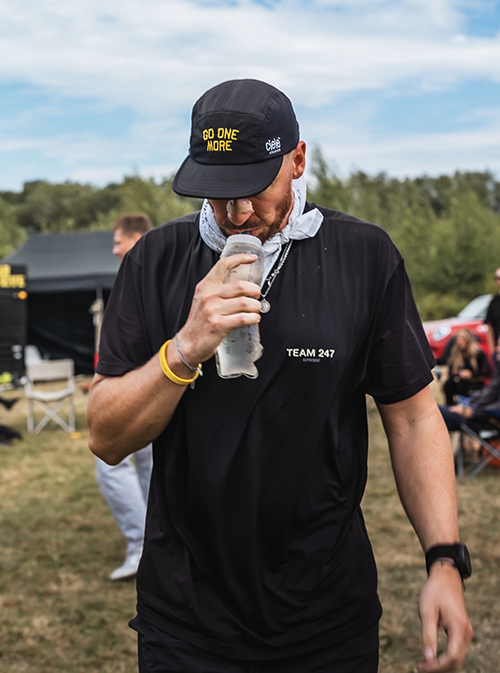
However, for a multi-day event like a Backyard Ultra, we took it a step further by utilizing post-hypnotic amnesia.
The mental weight of counting loops, anticipating fatigue, and remembering hours of physical discomfort can break an athlete faster than physical exhaustion. Through targeted suggestion, we conditioned James's subconscious to effectively forget each loop* the moment he returned from it.
Every time he stood at the starting line, his mind had already wiped the slate clean. He treated the next lap not as loop 35, 45, or 55, but as the very first one. This eradicated the monotony, bypassed the overwhelming psychological weight of the numbers, and allowed him to reset his relationship with physical pain every single hour.
Overcoming a Broken Body with an Ancient Motto
The true test of this psychological programming arrived at loop 30. James sustained an **ankle injury. His ankle swelled so badly that he couldn't even take his shoe off.
For most runners, a compromised ankle at mile 125 means immediate retirement. For James, it was a variable to manage. Alongside his pain-modulation tools, James anchored his mindset to a classic Latin motto we’d used on a previous Backyard Ultra: "Possunt quia posse videntur." This quotation, attributed to the philosopher Virgil, translates to: "They can because they think they can."
By deeply embedding this belief into his subconscious mind via hypnosis, James decoupled the physical sensation (pain) from emotional panic. Armed with the belief that his body would follow his mind's conviction, he put the pain in a mental box and powered through another 28 gruelling hours.
Compassion and Collaboration in the Crucible of Competition
Great performances are defined by character, not just medals.
As the race wore into a gruelling two-man war of attrition, James and Rob shared a unified goal: push each other far enough to unlock national selection. When Rob began to falter, James didn’t try to mentally break him. Instead, he used his psychological reserves to lift his rival, actively helping the other competitor around several laps.
Simultaneously, James’s support crew stepped up to assist Rob with nutrition and care. This display of ultimate compassion proves that elite psychological strength does not make you cold—it gives you an abundance of psychological resources to support others while fighting for your own survival.
Next Stop: The World Championships
After 58 gruelling hours and 241.7 miles, James tapped out on the final loop, providing the legendary "assist" that allowed Rob to take the win.
But in the Backyard Ultra, a great assist is a victory in itself. Because they pushed each other to such a historic depth, both James and Rob successfully qualified for the UK Team.
This October, both men will stand side-by-side in British kit, representing the UK at the World Team Championships.
Physical training builds the engine, but performance psychology dictates how long that engine can run before it breaks. When the body screams "no," a hypnotically anchored mind simply whispers: "Go one more"
*How Post-Hypnotic Amnesia Operates During the Race
- The Amnesic Block: When a cue is triggered (e.g. the moment an athlete enters the crew tent or sits in his seat at the end of a loop, the post-hypnotic suggestion activates.
- The Re-Set Effect: The brain temporarily locks away the memories of the pain and psychological distress suffered during that specific loop.
- The "First Lap" Perception: Because the working memory is blocked from dwelling on how hard the previous lap was, the athlete experiences a psychological phenomenon called proactive interference inhibition. They do not carry the "mental baggage" or dread into the next lap.
**Important Health and Safety Caveats
Pain vs. Suffering: the professional, ethical therapist using hypnosis will carefully separate suffering (the mental agony of effort) from acute pain (injury). Forgetting the mental grind is helpful, but completely blocking physical pain feedback could cause the athlete to run on an undetected injury, like a stress fracture. Therefore, a technique of sensation attenuation is used. Sensation attenuation effectively reduces how strongly the brain feels pain signals, rather than completely removing the feeling.
- The "Symptom Return": Once the race is entirely over and the athlete is out of the competitive state, the pre-arranged breakdown of the suggestion occurs, allowing the memories and fatigue to return so the body can properly rest and heal.
Are you preparing for an extreme endurance event, or looking to shatter your own psychological glass ceilings? Contact me today to discover how clinical hypnotherapy and performance psychology can unlock your subconscious potential.